
A floor lamp
Creative Writing Worksheet: The Floor Lamp
Introduction
This worksheet is designed to help you look at an everyday object in a deeper way. A simple object like a floor lamp is not just a thing—it can hold stories, emotions, memories, and imagination.
The purpose is not to write “correct answers,” but to observe carefully, think independently, and express freely. There is no right or wrong way to respond. Your own experience and imagination matter the most.
Step 1: Deep Observation (Look Closely)
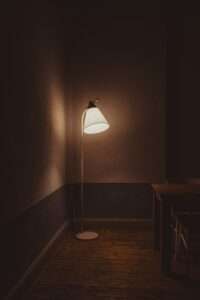
Sight (What do you see?)
- What is its shape, height, and color?
- Is it new, old, dusty, shiny, broken, or well-used?
- What kind of light does it give—bright, soft, yellow, white, warm, dull?
- What shadows does it create in the room?
✋ Touch (What would it feel like?)
- If you touch it, is it smooth, rough, cold, or warm?
- Does the switch feel soft, stiff, or clicky?
- Does the stand feel heavy or light?
Sound (What might you hear?)
- Does it make a click when switched on or off?
- Does it hum slightly when it is on?
- What sounds happen around it when it lights up the room?
Smell (What might be near it?)
- Does it smell like dust, metal, plastic, or fabric shade?
- Does the light change how the room smells feels?
Taste (Optional imagination)
- If this object had a taste, what would it be like and why?
Step 2: Emotional Connection
Think beyond the object.
- How does the floor lamp make you feel when it is on?
- Does it make the room feel safe, lonely, peaceful, or strange?
- Have you ever noticed it during night time or in silence?
- Does it remind you of any moment in your home?
Step 3: Memory Link
- Do you remember any night when only this lamp was on?
- Who usually switches it on or off in your house?
- Have you ever studied, read, or thought deeply under its light?
- Does it remind you of a festival, power cut, or rainy evening?
Step 4: Imagination Expansion
Now let your mind go beyond reality.
- If the floor lamp could speak, what would it say?
- What if it had seen every secret of your home?
- What kind of personality would it have—strict, friendly, silent, wise?
- What stories would it tell about the people who sit near it?
Step 5: Story Building
Try to turn your thoughts into a story.
- Start with: “One evening, the floor lamp in my room…”
- What happens next?
- Does something unusual occur?
- Does the lamp become important in the story?
Step 6: How to Expand One Idea into Another
Here is how your writing can flow naturally:
- Observation → Emotion
“The light is soft” → “It makes me feel calm and safe.” - Emotion → Memory
“It feels calm” → “It reminds me of studying quietly during exams.” - Memory → Imagination
“I studied under it” → “Maybe the lamp remembers all my thoughts.” - Imagination → Story
“The lamp remembers everything” → “One night, it starts speaking…” - Story → Reflection
“The lamp spoke” → “Maybe even small things around us hold silent stories.”
✍️ Sample Paragraph (Grade 8 Student Example)
The floor lamp in my living room is tall and simple. It has a cream-colored shade and a thin black stand. When I switch it on, the light spreads softly in one corner of the room, and everything feels quiet. I usually sit near it when I study at night. Sometimes I feel like the lamp is watching me work silently. During power cuts, it becomes the only light in the house, and the room feels different—calm but a little serious. Once, I was preparing for my exams, and I kept looking at the lamp when I was tired. It didn’t move or change, but somehow it made me feel steady. I think if it could talk, it would say, “Keep going, don’t stop in the middle.”
Thinking Patterns (Choose Any Path)
You can explore your writing using different thought paths:
1. Observation → Memory
What you see reminds you of something from your past.
2. Observation → Emotion
What you see creates a feeling inside you.
3. Observation → Imagination
What you see becomes something magical or unreal in your mind.
4. Observation → Story
What you see becomes the starting point of a story.
5. Observation → Reflection
What you see makes you think about life or people.
6. Observation → Conversation
What you see starts an imagined dialogue (lamp talking to you, or you talking to it).
Final Reflection
Take a moment to read what you have written.
- Did your writing stay close to your own thoughts?
- Did you add something from your imagination?
- Did one idea naturally lead to another?
Remember, the best writing is not copied. It comes from what you notice, feel, and imagine. Even a simple floor lamp can open a whole world of ideas—if you allow yourself to see it deeply.
Trust your senses. Trust your thoughts. Trust your voice.