
A Bathroom Mirror with Water Splashes
Object Writing Activity – A Bathroom Mirror with Water Splashes
Observe. Feel. Imagine. Write.
Name: _______________________
Grade: _______________________
Date: _______________________
Welcome!
Today, you are going to write about an ordinary object—a bathroom mirror with splashes of water.
At first, it may seem like a simple mirror. But if you observe carefully, you may notice many details that others miss.
There are no right or wrong answers.
The purpose of this activity is to observe deeply, think independently, and express your own ideas.
Don’t try to write like someone else.
Write what you notice.
Picture Observation
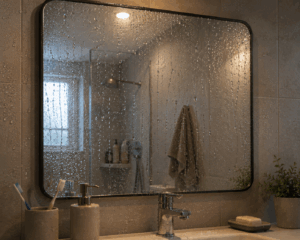
Look at the picture quietly for one full minute.
Don’t write immediately.
Notice every little detail.
Activity 1 – Observe with Your Eyes
Look carefully and answer in your own words.
- What is the first thing you notice?
- What shape is the mirror?
- Are the water droplets large or small?
- Are the splashes scattered or gathered in one place?
- Is the mirror completely clean or partly blurred?
- What colours do you notice around the mirror?
- Can you tell whether someone has just used the bathroom?
- What tiny details might another person miss?
Activity 2 – Explore Through Your Five Senses
Sight
Describe everything you can see.
Think about:
- reflections
- light
- shadows
- water drops
- fingerprints
- steam
- objects reflected in the mirror
✋ Touch
Imagine touching the mirror.
- Would it feel cold or warm?
- Would the water feel fresh?
- Would your finger slide across the glass?
- Is the frame smooth, rough, wooden or metal?
Hearing
Imagine standing in front of the mirror.
What sounds might you hear?
Maybe…
- dripping water
- running tap
- toothbrush
- hair dryer
- someone humming
- silence
What do you hear?
Smell
What smells belong in this place?
Maybe…
- soap
- shampoo
- toothpaste
- fresh towel
- perfume
- rainwater
Or something completely different.
Taste (Optional)
Creative writers sometimes connect objects with unexpected memories.
Does this mirror remind you of any taste?
Perhaps mint toothpaste…
Warm tea after brushing…
Or something only you remember.
Activity 3 – Make Personal Connections
Think beyond what you see.
- Does this mirror remind you of your home?
- Does it remind you of someone?
- Have you ever stood in front of a mirror for a long time?
- What thoughts usually come into your mind when you look into a mirror?
- Have you ever laughed, cried, practised a speech, or smiled in front of one?
- Why do you think this object feels familiar?
Activity 4 – Let Your Imagination Wander
Now imagine the mirror has a life of its own.
Complete any of these ideas.
- If this mirror could speak, it would say…
- The water drops are actually…
- Every morning the mirror watches…
- The funniest thing this mirror has ever seen is…
- One day the mirror decided to…
- The mirror remembers…
- If the reflection disappeared, what would happen?
Activity 5 – Build a Story
Objects often hide stories.
Imagine:
- Who was standing here a few minutes ago?
- Why are the water splashes still on the mirror?
- Was someone getting ready for school?
- Was someone in a hurry?
- Was someone practising a smile before an interview?
- Did someone receive good news?
- Did someone wipe away tears?
Create your own story.
Activity 6 – Expand Your Thoughts Naturally
Good writing grows like a conversation.
One idea gently leads to another.
For example:
You notice the water drops.
↓
They remind you of rain.
↓
Rain reminds you of your grandmother’s house.
↓
That reminds you of childhood mornings.
↓
You return to the mirror.
Notice how every idea stays connected.
Your thoughts can travel—but they should never feel random.
Your Writing Task
Write 10–15 meaningful sentences about the mirror.
Try to include:
✅ Observation
✅ Senses
✅ Feelings
✅ Memory
✅ Imagination
✅ Reflection
✅ A smooth flow of ideas
Don’t worry about using difficult vocabulary.
Simple writing with honest thoughts is always powerful.
Sample Writing
Written by Ishita Kulkarni
Grade 8
The bathroom mirror was covered with tiny drops of water that looked like little crystals. Some parts were clear while others were blurred. I imagined the glass feeling cold when I touched it. I could almost hear the sound of water dripping from the tap nearby. The smell of soap and fresh shampoo came into my mind. Looking at the mirror reminded me of getting ready for school every morning. Sometimes I smile at myself before leaving the house, and sometimes I look worried before an exam. I wondered how many different faces this mirror has seen every day. If it could speak, it would probably know everyone’s morning secrets. The water drops slowly disappeared, but the memories connected to the mirror stayed in my mind. It made me realise that even an ordinary mirror quietly watches hundreds of small moments in our lives.
Thinking Patterns (Idea Builder)
If you don’t know how to begin, try one of these thinking paths.
Pattern 1
Observation
↓
Memory
↓
Feeling
Example:
“I saw the water drops…”
↓
“They reminded me of…”
↓
“I felt…”
Pattern 2
Observation
↓
Imagination
↓
What if…?
Example:
“What if every reflection stayed inside the mirror?”
Pattern 3
Observation
↓
Story
↓
Character
↓
Event
Example:
“Someone must have stood here in a hurry…”
Pattern 4
Observation
↓
Emotion
↓
Reason
Example:
“The mirror looked lonely…”
↓
“because…”
Pattern 5
Observation
↓
Reflection
↓
Life Lesson
Example:
“The mirror shows faces…”
↓
“But people also hide feelings.”
Pattern 6
Observation
↓
Conversation
Example:
Imagine talking to the mirror.
Or imagine the mirror talking back.
Can You Create Your Own Pattern?
These are only starting points.
You might discover a completely new way of thinking.
That is exactly what creative writing is about.
Final Reminder
The sample paragraph is only an example.
Please don’t copy it.
Your memories are different.
Your imagination is different.
Your experiences are different.
That means your writing should also be different.
There is no perfect answer.
The best writers are not the ones who use the biggest words—they are the ones who notice deeply, think honestly, and write in their own voice.
Observe carefully. Feel freely. Imagine boldly. Write fearlessly.