
CELPIP Exclusive Practice Test 20 Sections80 LessonsLifetime
Reading Practice Test-1
The Reading Test is about 55 minutes.
There are four parts in Reading Section You will have 10 minutes to read each passage and answer the questions.
| Reading Sections | Time |
| Reading Sections: Part-1- Reading Correspondence (Email, letters, memos, report etc.) | 15 minutes |
| Reading Section:Part-2- Reading to apply a diagram | 10 minutes |
| Reading Section: Part-3-Reading for Information | 10 minutes |
| Reading Section: Part-3-Reading for Viewpoints | 20 minutes |
Reading Part 1: Reading Correspondence
Read the following message.
Dear [Bus Company Name],
I’m not one to typically write emails like this, but I had an experience with one of your bus drivers this morning that I felt compelled to share with you.
I recently moved from Gloucester to downtown, and navigating the local bus routes has been a bit of a challenge. I tried using the station map and even asked my apartment manager, but I still wasn’t completely clear about how to get around the city. Unfortunately, I couldn’t find any information kiosks near my home either. However, I eventually managed to figure it out using the online maps and schedules available on your website, www.catchmybus.com.
On the weekend, I planned my routes for the week, knowing I would need to take the #2 at Bank and Queen, and then transfer to the #42 at McLeod. Unfortunately, I didn’t get much rest over the weekend, and by Monday morning, I was running on little sleep. I arrived at Bank and Queen around 7:30 to catch the 7:37 bus. However, I accidentally dozed off while waiting for the bus to arrive. Thankfully, the driver noticed me and honked his horn to wake me up. His quick thinking saved me from being late on my first day of work! He greeted me with a warm smile and a “Good morning!” as I boarded the bus.
In my groggy state, I forgot to check the driver’s nametag, and almost left my bag on the bus. However, I hope you can track down his name based on the schedule and ensure that his excellent customer service is recognized.
Thank you very much for your attention to this. Please pass along my thanks to the driver.
Best regards,
[Your Name]
Question 1-6
Choose the best option according to the information given in the message.
Q.1 What was the main reason the person wrote the email?
a)To complain about a driver’s behavior
b) To share an unpleasant experience
c) To thank a bus driver for his excellent service
d) To ask for route information
Q.2 How did the person initially try to learn the bus routes?
a) By using an app on their phone
b) By asking a bus driver
c) By checking the map at the station and asking their apartment manager
d) By calling customer service
Q.3 What happened when the person missed the bus?
a)The bus left without stopping
b) The driver honked the horn to wake them up
c) The driver ignored them and continued driving
d) The person had to wait for the next bus
Q.4 What did the bus driver say when the person boarded the bus?
a)“Are you okay?”
b) “Good morning!”
c) “I’m sorry you missed the bus.”
d) “Hurry up, we’re late!”
Q.5 What was the person’s concern after boarding the bus? a) They forgot to pay their fare
b) They almost left their bag on the bus
c) They didn’t know which stop to get off at
d) They couldn’t find a seat
Q.6 What does the person want the company to do in response to the email? a) Refund their fare
b) Apologize for the inconvenience
c) Recognize the bus driver for excellent customer service
d) Provide additional route information
Read the following message.
The Role of Technology in Education
Technology has rapidly transformed every aspect of modern life, and education is no exception. In recent years, schools and universities have increasingly adopted digital tools to enhance learning experiences for students. From interactive whiteboards to online learning platforms, technology is helping to bridge the gap between traditional classrooms and modern teaching methods.
One of the biggest advantages of technology in education is its ability to make learning more accessible. Students can now access educational resources from anywhere in the world, as long as they have an internet connection. This has opened up new opportunities for students in remote or underprivileged areas who previously had limited access to quality education.
Moreover, technology allows for personalized learning experiences. Adaptive learning software, for instance, can tailor lessons to a student’s individual needs and pace, helping them to learn more effectively. This has proven to be especially useful for students with special learning needs or those who struggle in traditional classroom settings.
However, there are concerns about the over-reliance on technology in education. Critics argue that it can lead to distractions, as students may become more interested in the devices themselves than the lesson being taught. Others worry that technology may deepen the digital divide, leaving students in less affluent areas at a disadvantage due to a lack of access to the necessary tools.
Despite these concerns, many believe that the benefits of incorporating technology into education far outweigh the challenges. When used properly, technology can enhance learning, increase engagement, and provide valuable resources that improve educational outcomes.
Questions 7-11
Choose the best option according to the information given in the message.
7.What is one of the main benefits of technology in education, according to the article?
A) It increases classroom distractions
B) It makes learning more accessible
C) It eliminates the need for teachers
D) It limits students’ access to information
8.What is an example of personalized learning mentioned in the article?
A) Students working on group projects
B) Adaptive learning software
C) Teachers giving lectures
D) Online tests
9.What is one concern critics have about the use of technology in education?
A) Technology is too expensive for schools
B) Students may become distracted by the devices
C) It reduces the number of online resources available
D) It makes learning too easy
10. What is the “digital divide” mentioned in the article?
A) The separation between technology and non-technology
B) A gap in access to technology between different groups of students
C) The difference in teaching methods used in classrooms
D) The division between public and private schools
11.What is the article’s overall stance on technology in education?
A) Technology should be avoided in schools
B) Technology is only beneficial in certain subjects
C) The benefits of technology in education outweigh the challenges
D) Technology is harmful to students’ development
[/box]
Reading Part 2:
Reading to Apply a Diagram
Read the following message.
Energy-efficient Buildings:
- Advanced insulation materials, double-glazed windows, and solar panels.
- Designed to reduce energy consumption by up to 40%.
- Built to LEED (Leadership in Energy and Environmental Design) standards.
Green Roofs:
- Several buildings feature green roofs supporting plant growth.
- Helps absorb rainwater, reduce heat island effect, and improve air quality.
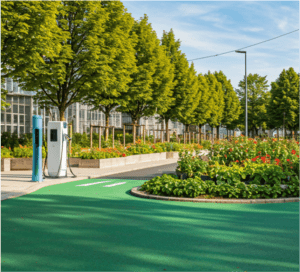
Electric Vehicle Charging Stations:
- 20 charging stations available 24/7.
- Easily accessible from all main roads in the development.
Public Green Spaces:
- Multiple green parks with benches, walking paths, and recreational facilities (playgrounds).
- Designed to promote a sense of community and enhance mental health.
Bicycle Lanes:
- Over 5 kilometers of dedicated bicycle lanes.
- Connects to nearby public transportation hubs and park areas.
Community Gardens:
- 3 large community gardens for residents to grow their own fruits and vegetables.
- Maintained with sustainable, organic practices.
Questions 1 to 8:
1.Which feature of the urban development is designed to reduce energy consumption?
A) Green roofs
B) Bicycle lanes
C) Energy-efficient buildings
D) Electric vehicle charging stations
2.How many charging stations for electric vehicles (EVs) are available in the development?
A) 15
B) 25
C) 20
D) 10
3.What is the primary purpose of the community gardens?
A) To improve aesthetic appeal
B) To reduce the need for grocery stores
C) To provide a space for organic farming
D) To encourage community interaction and provide a space for social activities
4.Which feature is specifically designed to improve air quality?
A) Electric vehicle charging stations
B) Green roofs
C) Bicycle lanes
D) Public green spaces
5.How long are the dedicated bicycle lanes in the neighborhood?
- A) 3 kilometers
- B) 10 kilometers
- C) 5 kilometers
- D) 8 kilometers
6.What is the main benefit of the green roofs in the urban development?
A) They enhance building aesthetics
B) They absorb rainwater, reduce the heat island effect, and improve air quality
C) They provide recreational spaces for residents
D) They offer spaces for community gardens
7.What type of transportation is directly connected to the bicycle lanes?
A) Electric vehicles
B) Public transportation hubs
C) Private cars
D) Walking paths
8.Which of the following is a feature that supports the environmental sustainability of the development?
A) Community gardens
B) Solar panels on roofs
C) Public green spaces
D) All of the abovev
/box]
Reading Part 3: Reading for Information
Read the following passage
Passage 1:
Passage 1:
The city of Ottawa is known for its vibrant cultural scene, which includes various museums, art galleries, and theaters. Visitors can enjoy beautiful green spaces like Major’s Hill Park, as well as cultural festivals held throughout the year. The National Gallery of Canada is a must-see for art enthusiasts, featuring both Canadian and international art. The city also has numerous restaurants, offering diverse cuisine to please every palate.
Passage 2:
Toronto’s skyline is dominated by the CN Tower, one of the tallest freestanding structures in the world. The city is a hub for finance, technology, and entertainment, attracting professionals from around the globe. Visitors often explore the Distillery District, known for its cobblestone streets and historic buildings, as well as the many festivals that take place in the city year-round. Toronto’s diversity is reflected in its multicultural population and global cuisine.
Passage 3:
Banff National Park, located in the Canadian Rockies, is a popular destination for outdoor enthusiasts. The park is famous for its stunning landscapes, including turquoise lakes, towering mountains, and lush forests. Hiking, skiing, and wildlife watching are some of the most popular activities. Banff’s town center is also a charming place, offering a variety of shops, restaurants, and accommodations for visitors seeking both adventure and relaxation.
Passage 4:
Vancouver is known for its beautiful natural surroundings, with beaches, mountains, and parks all within the city. Stanley Park, one of the largest urban parks in North America, offers walking and biking trails, as well as breathtaking views of the ocean and mountains. Vancouver is also a cultural center, home to a thriving arts scene, including theater, music, and dance. The city’s mild climate makes it an attractive destination for outdoor activities year-round.
Question 1-9
Decide which passage, 1 to 4, has the information given in each statement below. Select ‘e’ if the information is not given in any of the paragraphs.
1.Statement: “This city is known for its famous cultural festivals and diverse cuisine.”
a) Passage 1
b) Passage 2
c) Passage 3
d) Passage 4
e) None of the above
2.Statement: “Visitors can enjoy stunning views of the ocean and mountains from an urban park.”
a) Passage 1
b) Passage 2
c) Passage 3
d) Passage 4
e) None of the above
3.Statement: “The city has a large historic district with cobblestone streets and preserved buildings.”
a) Passage 1
b) Passage 2
c) Passage 3
d) Passage 4
e) None of the above
4. Statement: “This city is known for its diverse population and a thriving multicultural food scene.”
a) Passage 1
b) Passage 2
c) Passage 3
d) Passage 4
e) None of the above
5.Statement: “The city is famous for its outdoor recreational opportunities such as hiking, skiing, and wildlife watching.”
a) Passage 1
b) Passage 2
c) Passage 3
d) Passage 4
e) None of the above
6.Statement: “This city offers both modern city life and access to nature, with beaches, mountains, and parks within its boundaries.”
a) Passage 1
b) Passage 2
c) Passage 3
d) Passage 4
e) None of the above
7.Statement: “The city is home to one of the tallest freestanding structures in the world.”
a) Passage 1
b) Passage 2
c) Passage 3
d) Passage 4
e) None of the above
8.Statement: “Visitors to the city can explore both international and Canadian art collections in one of its prominent museums.”
a) Passage 1
b) Passage 2
c) Passage 3
d) Passage 4
e) None of the above
9.Statement: “The town center has shops, restaurants, and accommodations for visitors who are looking to relax after an adventurous day.”
a) Passage 1
b) Passage 2
c) Passage 3
d) Passage 4
e) None of the above
Reading Part 4: Reading for Viewpoints
Read the following article from a website.
The Importance of Public Transportation
Public transportation is a crucial part of urban life in many cities around the world. It not only provides a convenient and affordable option for daily commuting but also plays a significant role in reducing traffic congestion and minimizing environmental impact. As cities continue to grow, the need for efficient and accessible public transportation systems becomes even more pressing.
In addition to the practical benefits, public transit also fosters a sense of community. People from different walks of life often share the same buses or trains, creating opportunities for interaction and a greater sense of connection. Many cities are investing in modernizing their transit infrastructure to make it more accessible, including upgrades for people with disabilities and the introduction of environmentally friendly vehicles.
Despite these advantages, public transportation is not without its challenges. In some cities, there are complaints about overcrowded buses, delayed services, and inadequate routes. Additionally, the rising costs of maintaining public transit systems are a concern for city governments. However, experts argue that the long-term benefits of public transportation, including reduced traffic, cleaner air, and a stronger community, far outweigh these challenges.
As cities continue to expand, it is essential that governments prioritize the development of effective and sustainable public transportation systems. With proper investment and planning, public transit can be a key component of urban sustainability.
Question 1-9
Choose the best option according to the information given in the article.
- According to the article, what is one major benefit of public transportation?
- A) It increases air pollution
- B) It helps reduce traffic congestion
- C) It encourages people to drive more
- D) It is less cost-effective than driving
- What is mentioned as an ongoing issue with public transportation?
- A) Inadequate security measures
- B) Overcrowding and delayed services
- C) Lack of technology integration
- D) High rates of public satisfaction
- What is suggested as a potential solution to make public transportation more accessible?
- A) Limiting the number of buses on the road
- B) Introducing environmentally friendly vehicles
- C) Raising fares for all users
- D) Reducing the frequency of buses
- What is one of the primary concerns of city governments regarding public transportation?
- A) The environmental impact of buses
- B) The costs of maintaining transit systems
- C) The lack of customer satisfaction
- D) The need for new train stations
- What is the article’s stance on the future of public transportation?
- A) It should be replaced with more private transportation options
- B) It is no longer necessary for modern cities
- C) It should be a priority for government investment
- D) It should be eliminated to reduce government spending
- According to the article, what role does public transportation play in communities?
- A) It isolates people and limits interaction
- B) It fosters a sense of community by bringing people together
- C) It encourages people to spend more money
- D) It increases social inequality
- What is the article’s view on the environmental impact of public transportation?
- A) Public transportation has a negative environmental impact
- B) Public transportation is neutral in terms of the environment
- C) Public transportation helps reduce environmental impact
- D) Public transportation should be avoided due to its environmental harm
- What is the article’s opinion on the challenges faced by public transportation?
- A) Challenges are minimal and manageable
- B) Challenges are insignificant and should be ignored
- C) Challenges are real but outweighed by the benefits
- D) Challenges are impossible to overcome
- What does the article suggest about the future of public transportation in cities?
- A) Public transportation will become less relevant
- B) The government should invest less in public transportation
- C) Public transportation will remain a key aspect of urban life
- D) Public transportation should be limited to only certain areas
Answer Key
Questions
Answers
Reading Part 1
Reading to a correspondence
Q-1
c) To thank a bus driver for his excellent service
Q-2
c) By checking the map at the station and asking their apartment manager
Q-3
b) The driver honked the horn to wake them up
Q-4
b) “Good morning!”
Q-5
b) They almost left their bag on the bus
Q-6
c) Recognize the bus driver for excellent customer service
Q-7
b) It makes learning more accessible
Q-8
b) Adaptive learning software
Q-9
b) Students may become distracted by the devices
Q-10
b) A gap in access to technology between different groups of students
Q-11
c) The benefits of technology in education outweigh the challenges
Reading Part 2
Reading to apply a diagram
Q-1
c) Energy-efficient buildings
Q-2
c) 20
Q-3
c) To provide a space for organic farming
Q-4
b) Green roofs
Q-5
c) 5 kilometers
Q-6
b] They absorb rainwater, reduce the heat island effect, and improve air quality
Q-7
b) Public transportation hubs
Q-8
d) All of the above
Questions
Answers
Reading Part 3
Reading For Informations
Q-1
1.a) Passage 1
Q-2
d) Passage 4
Q-3
b) Passage 2
Q-4
b) Passage 2
Q-5
c) Passage 3
Q-6
d) Passage 4
Q-7
b) Passage 2
Q-8
a) Passage 1
Q-9
c) Passage 3
Reading Part 4
Reading For Viewpoints
Q-1
B) It helps reduce traffic congestion
Q-2
B) Overcrowding and delayed services
Q-3
B) Introducing environmentally friendly vehicles
Q-4
B) The costs of maintaining transit systems
Q-5
C) It should be a priority for government investment
Q-6
B) It fosters a sense of community by bringing people together
Q-7
C) Public transportation helps reduce environmental impact
Q-8
C) Challenges are real but outweighed by the benefits
Q-9
C) Public transportation will remain a key aspect of urban life
Reading Test Score Chart
Score
CELPIP Level
33–38
10-12
31-33
9
28-31
8
24-28
7
19-25
5
15-20
4
10-16
3
8-11
M
0-7
M
A Note About Your CELPIP Score
This chart illustrates how raw scores on the Reading Test correspond to the respective CELPIP levels. It is intended as a general reference only. Because questions can vary in difficulty and may be scaled differently, the raw score needed for a particular level may differ slightly between tests. This variation also accounts for the slight overlap in some score ranges.
| Questions | Answers | |
| Reading Part 1
Reading to a correspondence |
Q-1 | c) To thank a bus driver for his excellent service |
| Q-2 | c) By checking the map at the station and asking their apartment manager | |
| Q-3 | b) The driver honked the horn to wake them up | |
| Q-4 | b) “Good morning!” | |
| Q-5 | b) They almost left their bag on the bus | |
| Q-6 | c) Recognize the bus driver for excellent customer service | |
| Q-7 | b) It makes learning more accessible | |
| Q-8 | b) Adaptive learning software | |
| Q-9 | b) Students may become distracted by the devices | |
| Q-10 | b) A gap in access to technology between different groups of students | |
| Q-11 | c) The benefits of technology in education outweigh the challenges | |
| Reading Part 2
Reading to apply a diagram |
Q-1 | c) Energy-efficient buildings |
| Q-2 | c) 20 | |
| Q-3 | c) To provide a space for organic farming | |
| Q-4 | b) Green roofs | |
| Q-5 | c) 5 kilometers | |
| Q-6 | b] They absorb rainwater, reduce the heat island effect, and improve air quality | |
| Q-7 | b) Public transportation hubs | |
| Q-8 | d) All of the above |
| Questions | Answers | |
| Reading Part 3
Reading For Informations |
Q-1 | 1.a) Passage 1 |
| Q-2 | d) Passage 4 | |
| Q-3 | b) Passage 2 | |
| Q-4 | b) Passage 2 | |
| Q-5 | c) Passage 3 | |
| Q-6 | d) Passage 4 | |
| Q-7 | b) Passage 2 | |
| Q-8 | a) Passage 1 | |
| Q-9 | c) Passage 3 | |
| Reading Part 4
Reading For Viewpoints |
Q-1 | B) It helps reduce traffic congestion |
| Q-2 | B) Overcrowding and delayed services | |
| Q-3 | B) Introducing environmentally friendly vehicles | |
| Q-4 | B) The costs of maintaining transit systems | |
| Q-5 | C) It should be a priority for government investment | |
| Q-6 | B) It fosters a sense of community by bringing people together | |
| Q-7 | C) Public transportation helps reduce environmental impact | |
| Q-8 | C) Challenges are real but outweighed by the benefits | |
| Q-9 | C) Public transportation will remain a key aspect of urban life | |
Reading Test Score Chart
| Score | CELPIP Level |
| 33–38 | 10-12 |
| 31-33 | 9 |
| 28-31 | 8 |
| 24-28 | 7 |
| 19-25 | 5 |
| 15-20 | 4 |
| 10-16 | 3 |
| 8-11 | M |
| 0-7 | M |
A Note About Your CELPIP Score
This chart illustrates how raw scores on the Reading Test correspond to the respective CELPIP levels. It is intended as a general reference only. Because questions can vary in difficulty and may be scaled differently, the raw score needed for a particular level may differ slightly between tests. This variation also accounts for the slight overlap in some score ranges.